The Ice Water Trend: What the Science Actually Supports
Somewhere along the way, a real physiology fact turned into a weight-loss shortcut. Here’s the version of the ice water trend that survives contact with the actual research.
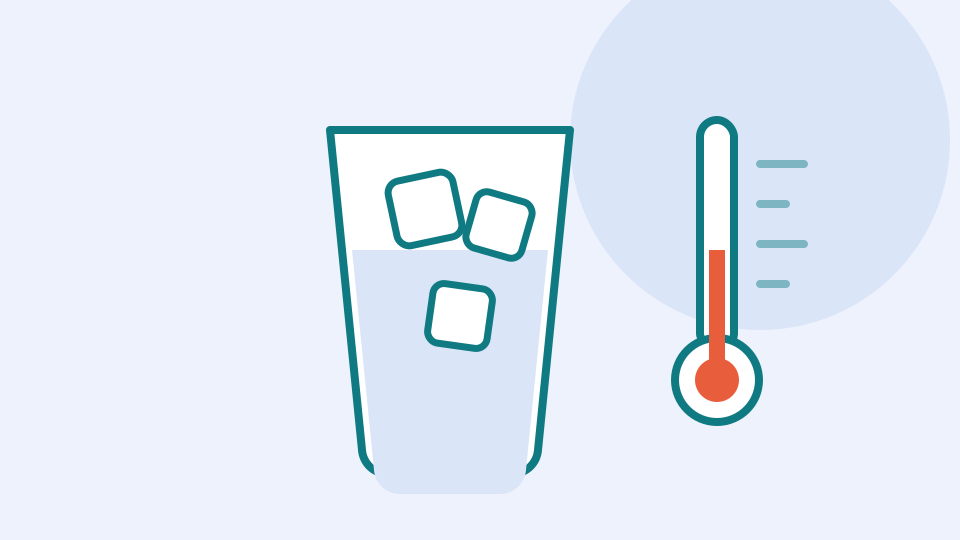
The claim, in its simplest form
The pitch is familiar by now: drink your water ice-cold, and your body has to burn extra energy warming it back up, so the colder the glass, the more you supposedly lose. It travels well because it is cheap, requires no willpower, and starts from something that is, in fact, real physiology — which is exactly why the exaggerated version is so hard to argue with in a fifteen-second video. If the hydration angle is what interests you, this longer piece on hydration and weight management covers fluid needs around exercise and meals in more detail.
The mechanism that's actually true
Your body keeps its core temperature inside a tight range. Anything colder that you swallow has to be warmed toward that range, and warming it costs energy — a process called thermogenesis. That part checks out. What doesn’t check out is the size of the number people attach to it.
Water has a fixed, well-documented specific heat capacity, and the gap between iced water and body temperature is limited. Multiply those two things together and you get a small, calculable, non-negotiable figure. It doesn’t grow because a headline wants it to. None of which makes water pointless — the CDC's page on water and healthier drinks explains the effect that does hold up: water has no calories, so it displaces the ones in sugary drinks.
Take whatever number you’ve seen quoted for “calories burned by cold water” and compare it to the calorie count of an average meal. That comparison is the whole argument. Cold water is a rounding error next to daily energy intake — not a treatment.
Why it can't carry a weight-loss plan on its own
Even under the most generous reading of the research, the effect is small enough to disappear into ordinary day-to-day noise: a bigger portion at dinner, a skipped walk, a rough night’s sleep. None of those get cancelled out by a cold glass of water.
There’s also a quieter cost. When a trivial trick gets billed as the mechanism, it pulls attention away from the handful of things that actually move the needle — food choices, activity, sleep, consistency. Someone faithfully icing their water while ignoring those has been handed a distraction, not a strategy.
What's genuinely useful here: hydration, not temperature
Strip the temperature claim away and there’s a real conversation left — about hydration. Being adequately hydrated supports several things that matter for anyone paying attention to their weight:
- Steadier energy. Mild dehydration is linked to fatigue and poor focus, which makes healthy choices harder, not easier.
- Less confusion between thirst and hunger. The two signals overlap. Drinking water first removes the guesswork.
- Fewer liquid calories. Choosing water over sugary drinks is one of the few genuinely simple swaps with a real effect — through calories, not temperature.
- Better training sessions. Hydration status affects how workouts feel and how you recover from them.
Cold or room temperature — does it matter?
Mostly, it comes down to what gets you drinking more. Some people find cold water easier to drink in volume; others prefer room temperature, especially around exercise. Pick whichever keeps the glass empty more often — that behavioural detail matters far more than the number on a thermometer.
A different topic: cold showers and ice baths
The ice water trend often gets lumped in with cold plunges and ice baths, but they’re not comparable. Whole-body cold exposure is a much bigger physiological stimulus, and it sits in an active, still-developing area of research on circulation, recovery and brown fat activity. Whatever conclusions eventually come out of that research, they don’t transfer to a glass of iced water, which involves a fraction of the thermal load.
The practical takeaway
- Use cold water as a hydration nudge, not a mechanism. If it gets you drinking more consistently, that's a genuine win.
- Anchor it to a habit you already have. First thing in the morning, with meals, or alongside a supplement taken per its label.
- Judge claims by scale. “Real” and “meaningful” are different words for a reason.
- Spend your actual effort on protein, fibre, movement and sleep — see natural weight management tips for where that effort tends to pay off.
AquaSculpt is often mentioned alongside this routine simply because the serving is taken with water, and cold water happens to be a common preference. That's the entire connection — the supplement's role, if any, is covered on the review page, not in a glass of ice.
Where AquaSculpt fits into a cold-water routine
The serving is taken with water per the current label. Cold water is a preference, not a mechanism — and no supplement can promise a specific result.
Frequently asked questions
Yes, in a technical sense — your body spends some energy warming cold water toward body temperature. But the amount is small next to daily energy use, and on its own it won't meaningfully change body weight.
For hydration, the difference is mostly about preference. What matters most is how much water you actually drink, not its temperature.
For most people it's simply a matter of taste. Some notice sensitivity with very cold drinks, particularly around the teeth or digestion. If that happens consistently, adjusting the temperature or checking in with a healthcare professional is reasonable.
No. Follow the current product directions. Cold water can be part of the routine if you prefer it, but temperature isn't a guaranteed mechanism and isn't the reason to choose any supplement.
Keep reading on AquaSculpt
If you want the product detail rather than the general guidance: the AquaSculpt homepage covers what the supplement is and how it is meant to be used, the about page explains the lifestyle-first approach behind it, the ingredient guide goes through every component in the supplied formula description, and the reviews page sets out how to evaluate it without relying on fabricated testimonials.
Important disclaimer
This article is for educational and informational purposes only. It is not intended to diagnose, treat, cure, or prevent any disease, and it is not a substitute for advice from a qualified healthcare professional. Dietary supplements cannot guarantee a particular weight-loss result, and individual outcomes vary.